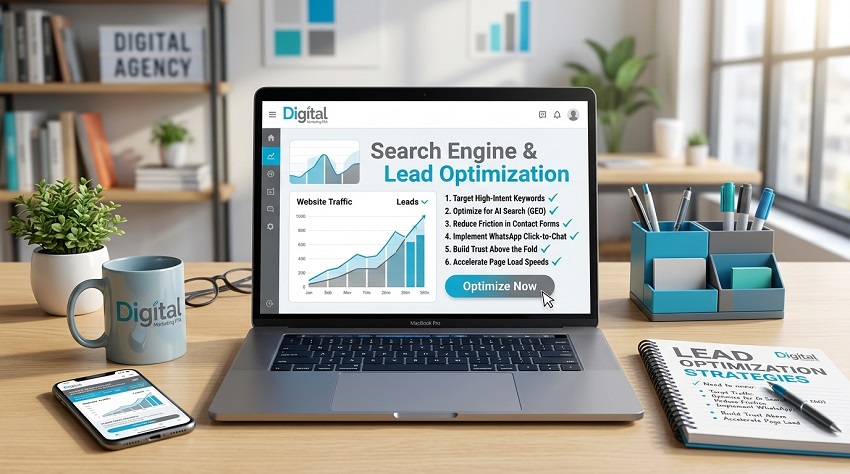
Attracting visitors to your website is only half of a successful digital growth strategy. When prospects land on a page, read a few lines, and exit without initiating contact, your marketing budget is generating traffic without revenue. To build a reliable sales pipeline, businesses must unify Search Engine Optimization (SEO)—which captures active buyer demand—with Lead Optimization—which removes friction and converts visitors into qualified inquiries.
How Do Search Engine Optimization and Lead Optimization Work Together?
Search Engine Optimization (SEO) and Generative Engine Optimization (GEO) bring high-intent prospects to your website, while Lead Optimization converts those visitors into paying customers through persuasive design, fast communication channels, and clear calls to action. Relying on SEO alone creates high traffic with low conversions, whereas optimizing for leads without search visibility leaves your best landing pages unseen.
| Strategy Component | Primary Objective | Key Execution Tactics | Core Business Metric |
| Traditional SEO | Rank in organic search results | Technical site health, local citations, service-specific landing pages | Organic impressions & clicks |
| AI Search (GEO) | Get cited in AI answers & summaries | Direct Q&A formatting, structured data, authoritative entity signals | Brand mentions & referral traffic |
| Lead Optimization | Turn website visitors into inquiries | Short forms, WhatsApp click-to-chat, visible social proof, fast load speeds | Conversion rate & qualified leads |
1. Capture High-Intent Buyers Instead of Passive Browsers
High traffic numbers mean very little if visitors have zero intention of buying. Restructuring your keyword strategy around commercial intent ensures your pages appear when decision-makers are ready to hire or purchase.
-
Target transactional search terms: Prioritize phrases containing commercial modifiers such as “company,” “services,” “pricing,” “quote,” and specific service locations (for example, “website design Midrand“ rather than broad terms like “how to make a website”).
-
Build dedicated service landing pages: Create a standalone, deeply informative page for every core service you offer. Single-focus pages rank more easily in search engines and speak directly to the visitor’s immediate problem.
2. Structure Content for AI Search Engines (GEO)
Search behavior has shifted toward conversational AI assistants, Google AI Overviews, and zero-click summaries. To ensure AI engines recommend your business when users ask for service providers, your content must be structured for machine readability.
-
Lead with direct, factual answers: Place a clear, 40-to-60-word summary directly beneath question-based headings before expanding into deeper explanations.
-
Use clean structural formatting: Break complex processes into bulleted lists, numbered steps, and comparison tables that AI models can easily extract and cite.
-
Establish clear entity credibility: Consistently display your company name, physical office address, direct contact numbers, and verified client reviews across your website and local business profiles.
3. Replace High-Friction Forms with Instant Messaging
Modern buyers expect immediate answers. When a mobile visitor has to fill out a ten-field contact form and wait 24 hours for an email response, they frequently move on to a faster competitor.
-
Deploy direct WhatsApp click-to-chat links: Integrating prominent WhatsApp buttons allows prospects to start a real-time conversation with your sales team in a single tap.
-
Streamline web inquiry forms: Where email forms are necessary, limit fields to the bare essentials—Name, Phone Number, Email, and Project Requirement.
-
Place calls to action strategically: Position clear action buttons (“Request a Quote,” “Chat on WhatsApp,” “Book a Consultation”) both above the fold and immediately following key benefit sections.
4. Engineer Landing Pages for Immediate Trust and Speed
A visitor decides within seconds whether your business looks credible enough to handle their money. Technical performance and visual trust signals directly determine whether they stay or bounce.
-
Showcase proof near decision points: Place verified Google review ratings, client testimonials, industry accreditations, and real project case studies right next to your contact buttons.
-
Eliminate slow page loads: Compress high-resolution images, minimize heavy scripts, and use reliable hosting so every page loads in under three seconds on mobile data connections.
Frequently Asked Questions
What is the difference between SEO and lead optimization?
SEO focuses on increasing your website’s visibility in search engines and AI answers to attract relevant visitors. Lead optimization (also known as Conversion Rate Optimization) focuses on improving your website’s layout, messaging, speed, and contact options so a higher percentage of those visitors become actual sales inquiries.
How long does it take to see more leads from search and conversion optimization?
Lead optimization changes—such as adding direct WhatsApp buttons, simplifying forms, and improving page speed—can increase conversion rates immediately from your existing traffic. Technical SEO and AI search visibility typically build momentum over 3 to 6 months as search engines index and reward your updated content.
Why is AI search optimization important for generating business leads?
Buyers increasingly use AI search tools to compare providers, check pricing expectations, and ask for local recommendations before visiting a website. Optimizing your content with clear answers, structured data, and strong local authority ensures your brand is included in those shortlists.
Ready to transform your website into a high-converting lead engine?
Digital Marketing Midrand specializes in custom, SEO-ready web design, Generative Engine Optimization (GEO), and conversion-focused digital marketing strategies built to grow businesses across Johannesburg and South Africa. Visit https://blog.digitalmarketingpta.co.za or message our team directly to discuss your project.